Culture et histoire Fact-check publié le 25/03/2026

⚠ Les Finlandais conservaient le lait en y mettant une grenouille vivante dedans
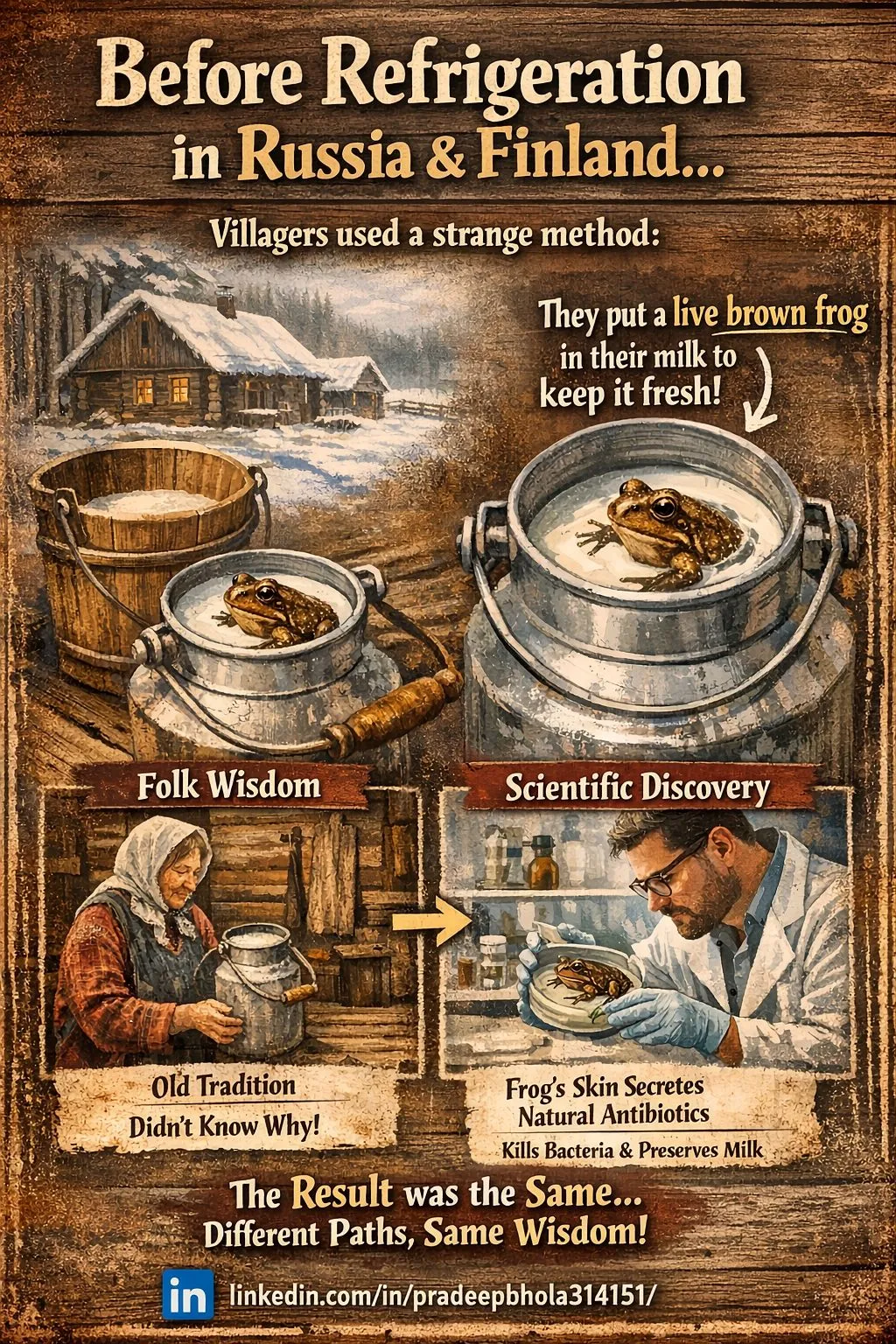
Le post original

Auteur
Posté sur LinkedIn
🧊 Before Refrigeration: When Tradition Solved Problems Before Science Could Explain Them Long before modern refrigeration, communities in cold regions like Russia and Finland faced a daily challenge: how to keep milk from spoiling quickly. Interestingly, historical accounts and later scientific observations point to a very unusual method used in some rural areas: 👉 People would place a live brown frog into containers of milk. At first glance, this sounds bizarre ~ even unhygienic. But when scientists studied amphibians much later, they uncovered something remarkable. 🔬 What Science Discovered: Frogs (and many amphibians) secrete antimicrobial peptides (AMPs) through their skin. These are: ✔ Natural defense compounds ✔ Capable of killing bacteria, fungi, and some viruses ✔ Being actively researched today for next-generation antibiotics Studies have shown that certain frog species like the European brown frog (Rana temporaria) produce peptides that inhibit microbial growth. 👉 In simple terms: These secretions could slow down bacterial activity, which is the primary reason milk spoils. 🧠 What This Means: Villagers didn’t understand microbiology, peptides, or bacteria. But through observation, trial, and generational knowledge, they discovered something that worked. ✔ Milk lasted longer ✔ Waste reduced ✔ Survival improved The method was empirical. The explanation came centuries later. 🌍 Not an Isolated Case: This isn’t the only example where tradition preceded science: • Fermentation (curd, kimchi, sauerkraut) preserved food before microbes were known • Turmeric used in India for healing long before its anti-inflammatory properties (curcumin) were studied • Neem used for hygiene and pest control prior to modern biochemistry 💡 The Bigger Insight: This story isn’t really about frogs or milk. It’s about how knowledge evolves. 👉 Tradition = Experimentation over generations 👉 Science = Explanation through structured evidence When both align, we get powerful insights. ⚖️ Important Note: This doesn’t mean all traditional practices are safe or scientifically valid. Each claim needs proper validation. But it does remind us that human observation has always been a powerful tool. ✨ Final Thought: Sometimes, people had the right answers… just not the language to explain them. Different paths. Same truth. What’s one traditional practice you’ve seen that later turned out to have scientific backing? 👇 #ScienceFacts #FolkWisdom #HistoryMeetsScience #DidYouKnow #HumanInnovation #AncientKnowledge #ModernScience #Curiosity #LearningEveryday #CriticalThinking #BiologyFacts #Microbiology #Storytelling #KnowledgeSharing #LinkedInIndia
Original post image

Le fact-check

⚠️ There is no evidence that this practice was actually used, but a scientific study on the antimicrobial properties of frog skin does exist. In 2012, researchers found that the skin secretions of the common brown frog (Rana temporaria), native to Russia, contain numerous antimicrobial peptides with antibiotic properties. https://cvc.li/OfdrM Scientists suggest these molecules could have medical potential and might explain the popular belief that placing a frog in milk preserves it. In reality, the Russian/Finnish legend likely comes from farmers occasionally finding frogs in milk containers, which led to various expressions and beliefs https://cvc.li/sCqfF https://cvc.li/ikdYD https://cvc.li/xGqAq https://cvc.li/QCwbq The study also cautions: “Some natural substances work well in the lab but become ineffective or toxic when used in humans.” https://cvc.li/xMusd As for other methods mentioned, their origins are uncertain and likely accidental. In the case of turmeric, this property has no scientific proof. The important note on this post rightly reminds us that not everything is true and that claims must be scientifically verified https://cvc.li/YgjlP https://cvc.li/nABKh https://cvc.li/JUMPi https://cvc.li/bnlzM

Historique

2 étapes
25 mars • 21:41

Post Reçu

25 mars • 22:52

Publication

⚠️ There is no evidence that this practice was actually used, but a scientific study on the antimicrobial properties of frog skin does exist. In 2012, researchers found that the skin secretions of the common brown frog (Rana temporaria), native to Russia, contain numerous antimicrobial peptides with antibiotic properties. https://cvc.li/OfdrM Scientists suggest these molecules could have medical potential and might explain the popular belief that placing a frog in milk preserves it. In reality, the Russian/Finnish legend likely comes from farmers occasionally finding frogs in milk containers, which led to various expressions and beliefs https://cvc.li/sCqfF https://cvc.li/ikdYD https://cvc.li/xGqAq https://cvc.li/QCwbq The study also cautions: “Some natural substances work well in the lab but become ineffective or toxic when used in humans.” https://cvc.li/xMusd As for other methods mentioned, their origins are uncertain and likely accidental. In the case of turmeric, this property has no scientific proof. The important note on this post rightly reminds us that not everything is true and that claims must be scientifically verified https://cvc.li/YgjlP https://cvc.li/nABKh https://cvc.li/JUMPi https://cvc.li/bnlzM

Vous avez une question, une remarque ou une suggestion ? Contactez-nous, nous vous répondrons au plus vite !

Nous contacter

Posez votre question à VeraVera