Sciences Fact-check publié le 15/06/2025

✅ Les courbures sont plus attirants
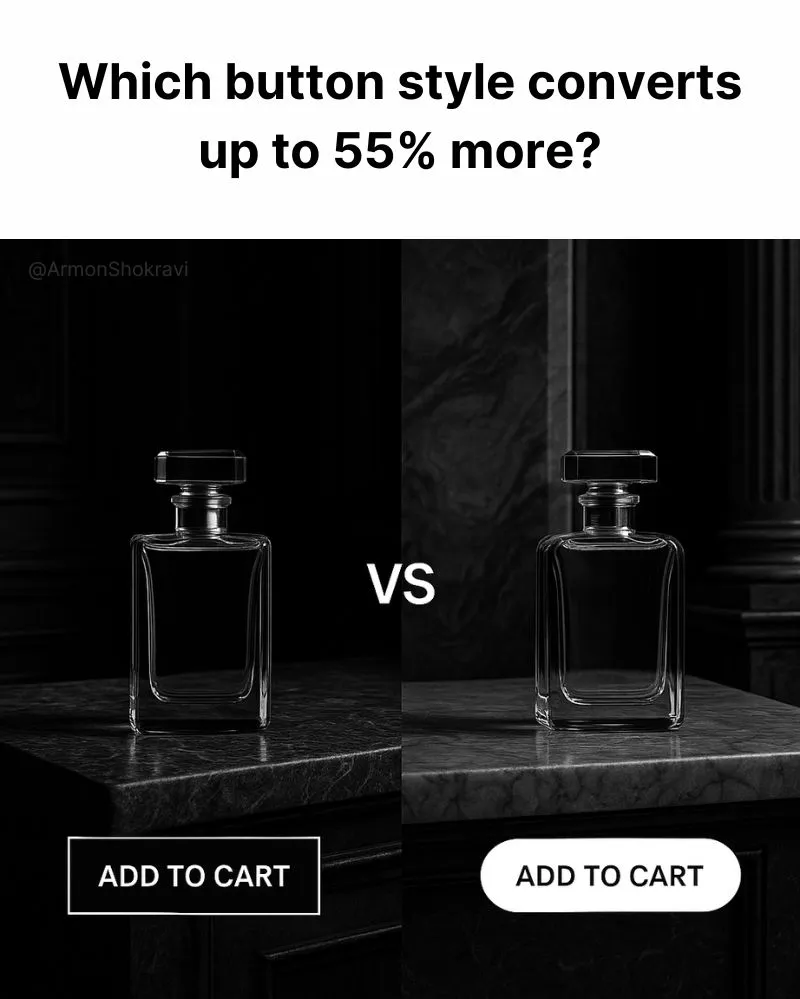
Le post original

Which converts up to 55% more: Round or Square? The science says CURVY. Round buttons get at least 17% more clicks In some tests, results were up to 55% higher On mobile, the AVG was a 25.7% increase 👀 Why? Let's dig into the psychology. You've probably noticed that most DTC websites use rounded CTA buttons. But what is actually driving this from a behavioral psychology perspective? AKA... why do we buy more when the only change is button shape? A 2023 study published in the Journal of Consumer Research found that round CTA buttons consistently outperformed sharp edged buttons with multiple tests validating this on desktop and mobiel for ecom purchases. The underlying psychology roots back to our ancestry. Think caveman and cavewoman energy. We instinctively perceive sharp angles as dangerous and curves as safe, friendly, and trustworthy which even 1000s of years later, translates to what's called "approach vs avoidance behavior" AKA: ✅ We’re drawn to things that feel approachable ❌ We avoid what feels threatening That bias shows up in how we look at and click CTAs. We literally project qualities onto the brand. Round signals = safe, more friendly, approachable Which translates in our head to: "Customer support will be fast and friendly" "I can probably return it easily" And things like that. There's a lot of science behind this simple swap btw: In a lab simulation of a shopping interface, participants were 46% more likely to click a curved button to complete an optional task. Another factor is our eye gaze. We gravitate towards rounded objects more. One of their supporting eye tracking studies found that participants looked at rounded buttons 28.6% onger and their gaze returned to those buttons 61.8% more often. Which is a relevant tip if you have a button in your retargeting ads. These tests controlled for color, copy, placement, and device The only variable was the corner shape of the CTA button NOTE: There are no "always true" rules for DTC. Obviously test what works for your brand. But by default, I'd start curvy ✌️ P.S. If you want to nerd out on the science behind it: check out the full original research here: Curvy Digital Marketing Designs: Virtual Elements with Rounded Shapes Enhance Online Click-Through Rates in the Journal of Consumer Research (2023)
Original post image

Le fact-check

✅ It’s true that people tend to click more on round buttons than sharp ones. This is likely because round shapes are perceived as more visually appealing, which draws more visual attention and increases click likelihood.(https://lc.cx/Qshr9E) The authors of this study do mention a link between sharpness and threat, but they emphasise the round shapes “attractiveness” as the key factor influencing user preference. Interestingly, this preference is observable even in newborns (https://lc.cx/DTRrfU). While one might infer that some innate threat-avoidance is at play, the study doesn’t mention sharpness—suggesting the effect may be more complex than a simple “round = safe vs. sharp = threatening”. Some hypotheses point to aesthetic archetypes that may be acquired from birth (e.g. https://lc.cx/CbYkyR). ❌ So, there's no conclusive evidence that round buttons feel safer than sharp ones. It might just be appearance preferences. ✅The 28.6% figure mentioned in the post is true, even though it’s not framed that way in Biswas' article. Curved elements received a total gaze time of 740.50 ms, compared to 575.91 ms for sharp ones. Same for the “61.8%” revisits to curved elements over sharp ones.

Historique

2 étapes
13 juin 2025 • 08:53

Post Reçu

15 juin 2025 • 19:46

Publication

✅ It’s true that people tend to click more on round buttons than sharp ones. This is likely because round shapes are perceived as more visually appealing, which draws more visual attention and increases click likelihood.(https://lc.cx/Qshr9E) The authors of this study do mention a link between sharpness and threat, but they emphasise the round shapes “attractiveness” as the key factor influencing user preference. Interestingly, this preference is observable even in newborns (https://lc.cx/DTRrfU). While one might infer that some innate threat-avoidance is at play, the study doesn’t mention sharpness—suggesting the effect may be more complex than a simple “round = safe vs. sharp = threatening”. Some hypotheses point to aesthetic archetypes that may be acquired from birth (e.g. https://lc.cx/CbYkyR). ❌ So, there's no conclusive evidence that round buttons feel safer than sharp ones. It might just be appearance preferences. ✅The 28.6% figure mentioned in the post is true, even though it’s not framed that way in Biswas' article. Curved elements received a total gaze time of 740.50 ms, compared to 575.91 ms for sharp ones. Same for the “61.8%” revisits to curved elements over sharp ones.

Vous avez une question, une remarque ou une suggestion ? Contactez-nous, nous vous répondrons au plus vite !

Nous contacter

Posez votre question à VeraVera