Technologie et réseaux sociaux Fact-check publié le 18/02/2026

✅ La puce quantique de Google est 13 000 fois plus rapide que les meilleurs super PCs
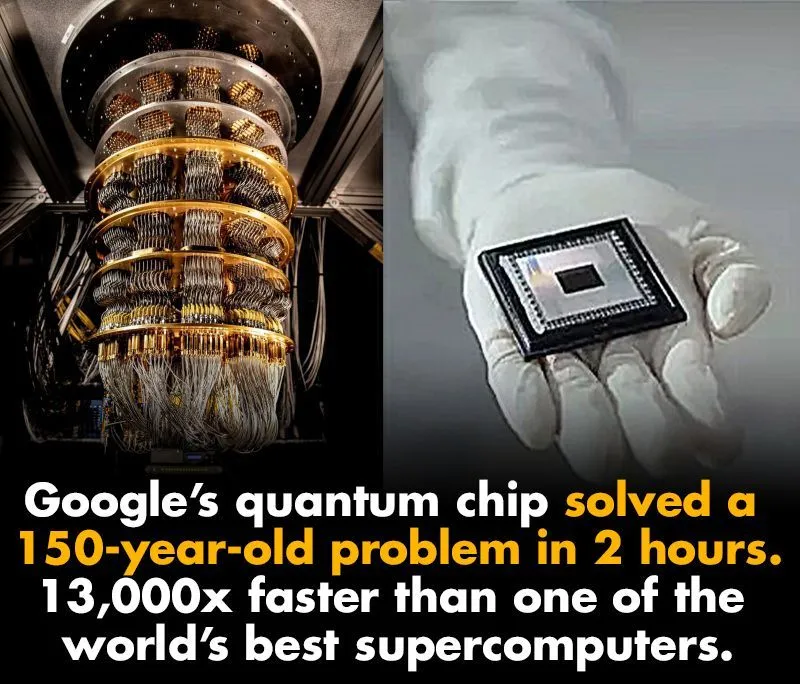
Le post original

I’ve been waiting for a moment like this. Google’s new quantum chip solved a 150-year-old problem in 2 hours. 13,000× faster than one of the world’s best supercomputers. That’s not incremental. That’s a different category. Their Willow chip ran an algorithm that models how atoms interact inside molecules. In simple terms, it gives us a new way of seeing structures that were previously invisible. As someone who has watched AI transform software, this feels similar. A shift in what’s computable. If this holds, it won’t just mean faster simulations. It could mean: → Faster drug discovery → New materials → New physics → And eventually, new tools for AI itself AI changed how we process information. Quantum may change what we can even understand. And that’s bigger. So here’s the question I’m thinking about: Are we ready for a world where the hardest problems stop being computationally impossible? #QuantumComputing #AI #Innovation #FutureOfWork #Technology #Science
Original post image

Le fact-check

✅ It’s true but we are not at a fully general quantum advantage yet. In October 2025, H Neven; VP at Google Quantum AI announced a major speed breakthrough. His team calculated that : • A 65-qubit problem took about 2 hours on their “Willow” Google’s quantum chip. • A similar 40-qubit version takes days on high-end GPUs. • Running the full 65-qubit version on the Frontier supercomputer would take an estimated 3.2 years. https://cvc.li/nIrko The experiment looked at how quantum information spreads in complex, chaotic systems using a kind of “echo” technique called the 2nd-order out-of-time-order correlator, or OTOC(2). Google Quantum AI argues that their quantum processor could help “learn” the hidden physics of a system and improve how scientists analyse magnetic materials, molecules, and chemical reactions. For example, extending the range of nuclear magnetic resonance (NMR) spectroscopy. But there are important limitations. The speedup only applies to a specific class of measurements, not to all problems. Classical simulation and the Frontier Computer are still improving. Current quantum hardware still has relatively high error rates (not fault-tolerant). The full peer-reviewed paper is here : https://cvc.li/DPLzW

Historique

2 étapes
17 févr. 2026 • 13:53

Post Reçu

18 févr. 2026 • 10:00

Publication

✅ It’s true but we are not at a fully general quantum advantage yet. In October 2025, H Neven; VP at Google Quantum AI announced a major speed breakthrough. His team calculated that : • A 65-qubit problem took about 2 hours on their “Willow” Google’s quantum chip. • A similar 40-qubit version takes days on high-end GPUs. • Running the full 65-qubit version on the Frontier supercomputer would take an estimated 3.2 years. https://cvc.li/nIrko The experiment looked at how quantum information spreads in complex, chaotic systems using a kind of “echo” technique called the 2nd-order out-of-time-order correlator, or OTOC(2). Google Quantum AI argues that their quantum processor could help “learn” the hidden physics of a system and improve how scientists analyse magnetic materials, molecules, and chemical reactions. For example, extending the range of nuclear magnetic resonance (NMR) spectroscopy. But there are important limitations. The speedup only applies to a specific class of measurements, not to all problems. Classical simulation and the Frontier Computer are still improving. Current quantum hardware still has relatively high error rates (not fault-tolerant). The full peer-reviewed paper is here : https://cvc.li/DPLzW

Vous avez une question, une remarque ou une suggestion ? Contactez-nous, nous vous répondrons au plus vite !

Nous contacter

Posez votre question à VeraVera