
Économie et société
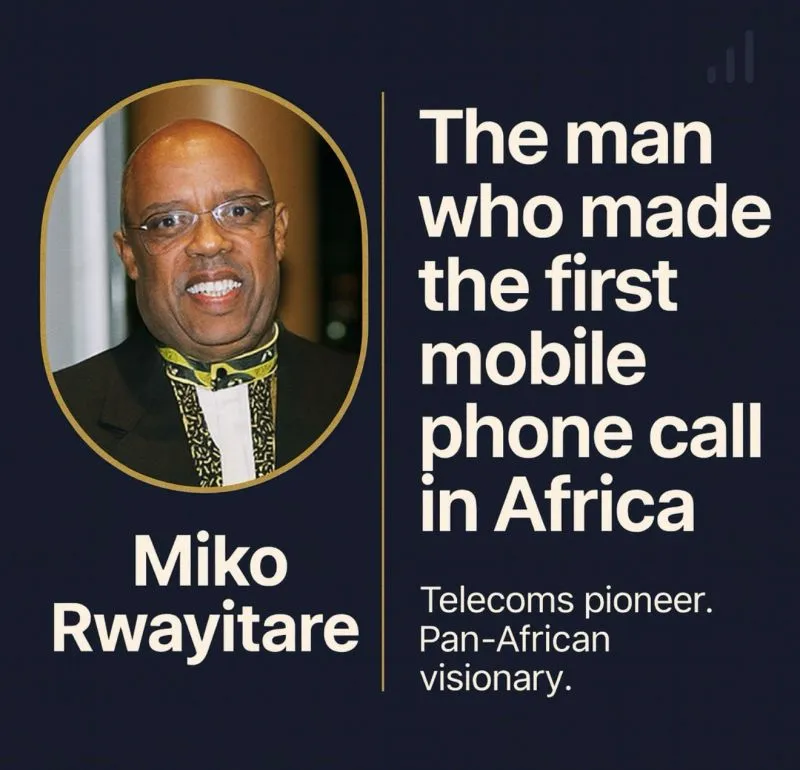
Miko Rwayitare est le père des télécoms en Afrique
Le post
Voir sur
Most people who benefit from mobile phones in Africa today have no idea who Miko Rwayitare was. But we should. His legacy touches every single one of us. Miko showed, long before “ecosystem,” “startups,” or “venture capital” entered our vocabulary, that an African-owned telecom company could scale across borders, compete globally, and win.
Miko was a Rwandan-born billionaire and is widely known as the “father of mobile telecommunications in Africa”. It is reported that he made the first cellular phone call on the African continent in 1986.
Born in 1942, he grew up partly in what was then Zaire (now DRC), and later studied engineering in Germany. He could easily have stayed abroad, built a comfortable life, and watched Africa from a distance. Many did. But he chose a path that would change the continent forever.
When he returned to Africa, he worked for Gécamines, one of the biggest mining companies in Zaire. Later, he founded a technology distribution firm, selling HP and Xerox equipment across Central Africa. That exposure to hardware, logistics, and the realities of building tech businesses on African soil planted the seeds of a much bigger vision.
In 1986, when no one thought Africa was “ready” for mobile phones, Miko founded Telecel International.
He negotiated directly with President Mobutu’s government for a private cellular license- a first in Africa at a time when telecoms were tightly controlled by the state. Somehow, through conviction and grit, he succeeded. Telecel opened its doors in Kinshasa, and in 1986, Miko made what is considered the first mobile phone call ever made on African soil.
First call, first signal, first connection.
Telecel grew quickly, expanding into more than a dozen African countries. He built at a time when there were no innovation hubs, angel investors, accelerators, or safety nets.
And his journey didn’t end with telecom.
Later, in South Africa, he invested through Mikcor Investment Holdings across real estate, hospitality, agriculture, even owning a vineyard, one of the first Black Africans to do so.
Today, everything- from mobile money to e-health to e-learning to the entire digital economy- sits on the foundation laid by pioneers like Miko.
We honour Miko not just by remembering his name, but by building with the same courage, daring, and belief in African potential. His life was a blueprint for pan-African ambition before the term even existed.
#Pioneers #Innovation #Leadership #Telecoms #HistoryMakers #DRC #Rwanda #Inspiration #Storytelling #Legacy
Le débunk
✅ True with some nuances
A heartfelt tribute to Miko Rwayitare (1942–2010), who left a lasting mark on Africa’s telecommunications history. As the founder of Telecel, he is recognised as one of the continent’s first mobile pioneers. Telecel International has its roots in the late 1980s, and the holding was officially established in 1993 to support the operator’s pan-African expansion https://tinyurl.com/435exee3
Although his impact is clear, certain details of Miko Rwayitare’s early achievements are less well documented. Some sources suggest he may have been among the first to make a mobile phone call in Africa, though this is difficult to verify.
Similarly, the claim that he directly negotiated with Mobutu’s regime for the first private mobile phone licence in Africa is difficult to verify independently.
Beyond these specifics, Miko Rwayitare deserves recognition for his visionary foresight : he identified the potential of mobile telephony in Africa long before most, and turned it into reality despite a challenging environment. His determination and tenacity in overcoming obstacles paved the way for an entire industry, showing that an African entrepreneur could transform an ambitious idea into real impact.
Vous avez une question, une remarque ou une suggestion ? Contactez-nous en en indiquant le titre du débunk. Nous vous répondrons au plus vite !
Contactez-nous